
Develop More Before You Deploy
Physical testing is essential, but it should not be the only place a robot learns. We use industrial robotics simulation to test motion, perception, control, sensing, and operating scenarios before hardware is exposed to them. This creates more opportunities to find problems and compare approaches without consuming physical machine time.
Build the Environment, Then Test the Robot
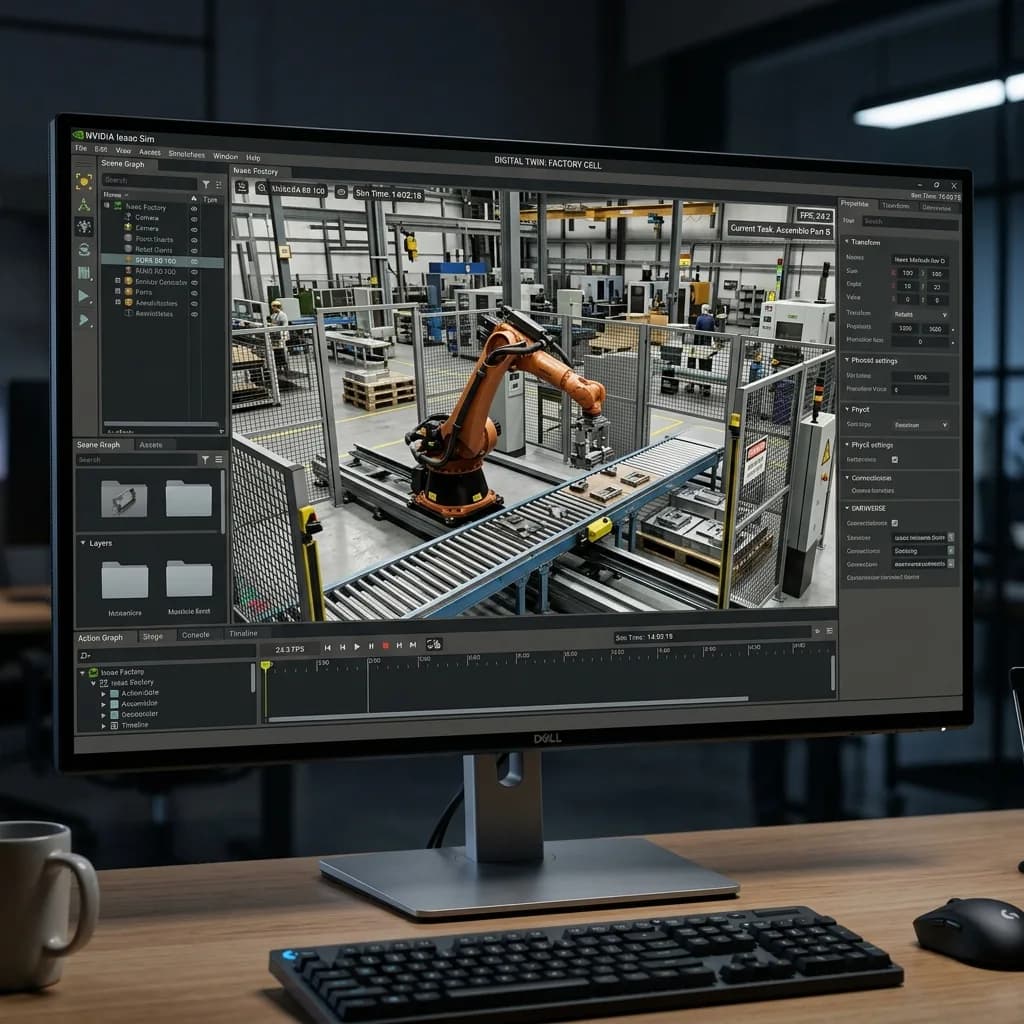
Useful simulation starts with an environment that behaves like the real one. We build virtual work cells, facilities, robot setups, sensors, obstacles, and operating conditions for pre-deployment testing. Where appropriate, we use NVIDIA Isaac Sim for high-fidelity simulation and synthetic data, with NVIDIA Isaac Lab supporting scalable robot-learning workflows. The aim is a useful test environment, not a virtual world for its own sake, with ai robot training simulation adapted to the task and operating environment.
Scale GPU Accelerated Robot Training Without Scaling Physical Tests
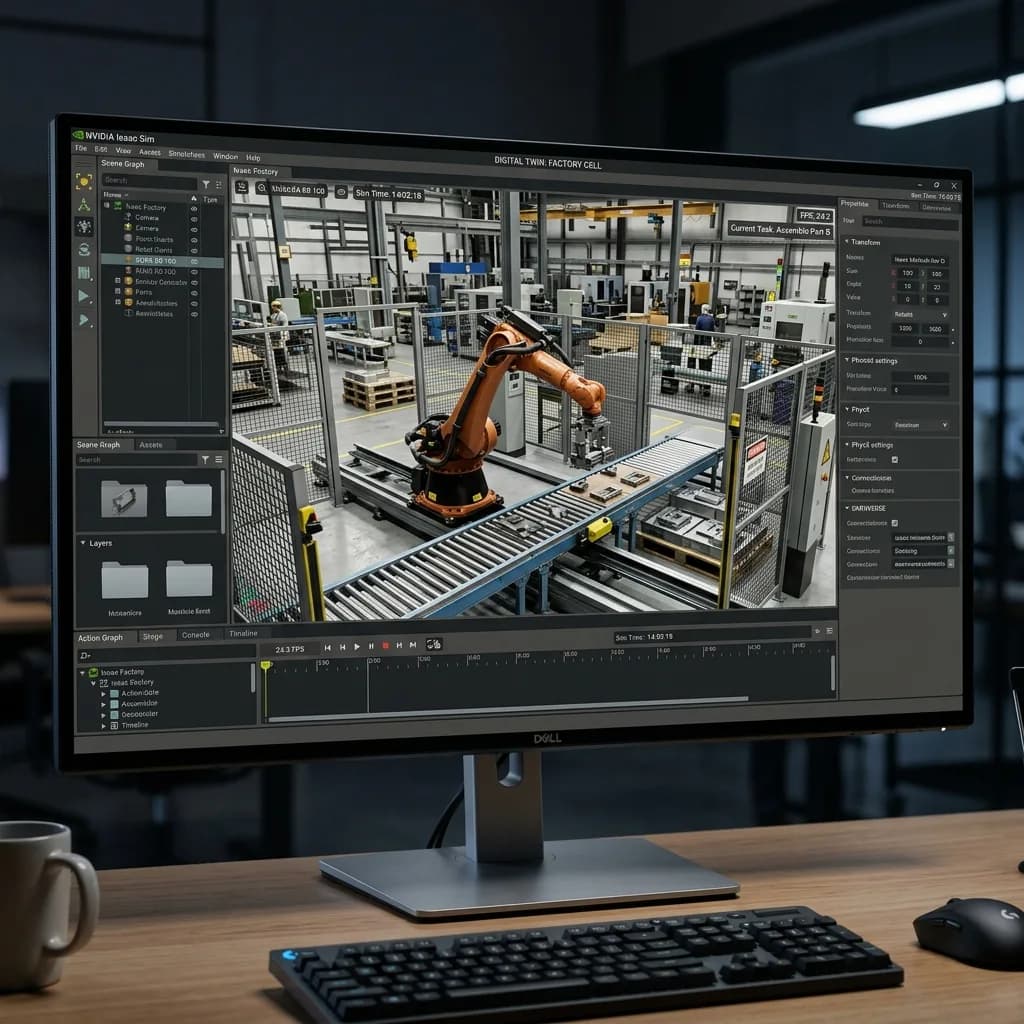
Our gpu accelerated robot training workflows run many simulated trials in parallel, allowing teams to compare behaviours and iterate on policies without waiting for physical hardware. For reinforcement learning, domain randomization robotics introduces controlled variation in lighting, surfaces, sensor noise, and object positions, helping behaviours handle real-world conditions. This supports gpu accelerated robot training for industrial robots before deployment.
Build the Training Data Your Robot Actually Needs
Robot vision can stall when real-world examples are difficult or expensive to collect and label. We use simulation to generate automated labeled training data across controlled variations of objects, poses, lighting, camera positions, and environments. This expands datasets for inspection, recognition, localization, and manipulation while keeping the data relevant to the robot's operating environment. Synthetic data complements real-world data and provides targeted computer vision training data for difficult edge cases.
Turn Simulation Results Into Real-World Robot Behaviour
Simulation creates value when learned behaviour transfers to the physical system. We calibrate the simulated robot and environment, introduce controlled variation, test difficult scenarios, and validate progressively on real hardware. Domain randomization robotics helps reduce sensitivity to simulation-to-reality differences, while staged validation identifies where further tuning is needed. This turns gpu accelerated robot training into deployable capability, particularly for robotics reinforcement learning.
Choose the Tools Around the Robot, Not the Other Way Around
Our simulation stack is built around the requirements of the robot and the problem being solved. That can include high-fidelity environment simulation, robot and sensor models, GPU-based learning, synthetic data pipelines, physics-based testing, and software-in-the-loop or hardware-in-the-loop validation. We use platforms such as NVIDIA Isaac Sim and Isaac Lab where they provide the right foundation, while keeping the workflow open to other simulation and learning frameworks when they better suit a specific robot, task, or integration. The emphasis is on building a repeatable development pipeline that engineers can use from early experimentation through validation and deployment. For teams working on robot learning simulation, this creates a consistent path from virtual experiments to physical validation.
Make Simulation Useful to the People Operating the System
Simulation does not have to stop when the robot leaves the virtual environment. We extend the same models and data into ar robot simulation, VR training, design review, maintenance guidance, and remote supervision where those capabilities add practical value. The result is a more connected workflow in which engineers can review layouts, operators can train in representative environments, and technicians can access relevant digital information while working with physical equipment. This also supports gpu training for robotics industrial automation where simulation needs to connect with wider engineering and operational workflows.
Review layouts, work cells, and operating scenarios before implementation while giving teams a safe training environment.
Bring relevant simulation and digital-model information into maintenance, assembly, inspection, and service workflows.
Use simulation and digital representations to support remote supervision and teleoperation with clearer views of robot state and task progress.