
What is a Digital Twin?
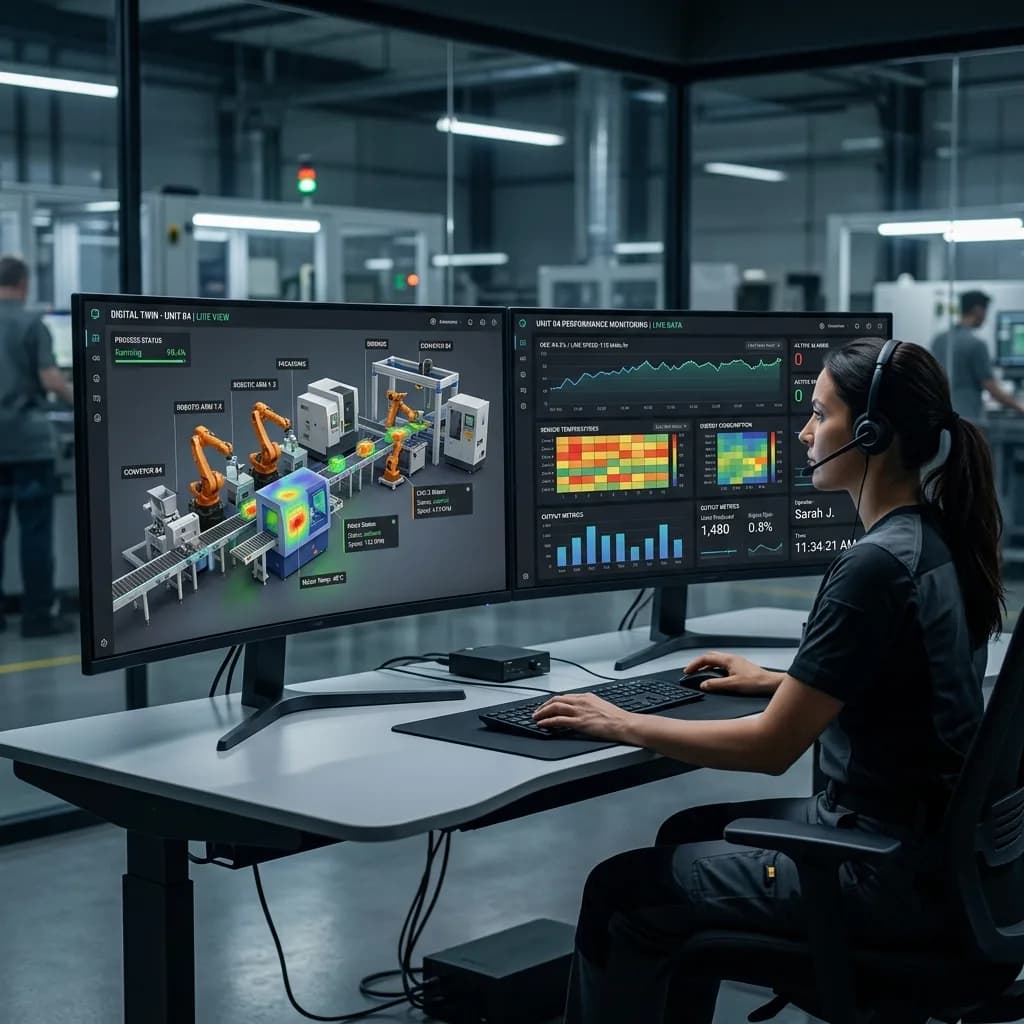
A useful digital twin connects the physical system to a live digital model, combining geometry, operational data, equipment state, and behaviour. This gives engineering and operations teams a current view of the system and a controlled environment for testing what could happen next, supporting digital twin development, simulation, monitoring, and optimization.
The Levels of Twin
Different types of digital twins support different levels of operational visibility:
A single machine or component, represented with its geometry, sensors, and operating data.
A robot's geometry, kinematics, and live state for monitoring, programming, and simulation.
A connected line or cell representing flow, bottlenecks, and interactions across the operation.
A whole plant or operation for visibility, optimization, and coordination across connected systems.
What a Twin Enables
We surface live equipment values, operating states, and key telemetry directly inside the 3D digital twin, so teams can understand physical conditions in their spatial context.
Equipment status, warnings, and configurable operating ranges appear against the relevant asset instead of across disconnected dashboards.
Test equipment behaviour, layouts, and proposed changes virtually before committing physical resources or taking systems offline.
Combine live equipment data with models and AI to identify changing conditions and support digital twin for predictive maintenance workflows.
Compare scenarios, identify constraints, and refine operating conditions without experimenting directly on the live system.
Give teams a shared environment for training, remote review, maintenance planning, and understanding equipment behaviour before working on the physical asset.
How We Build Them
We build a digital twin around the system it represents, starting with accurate geometry from CAD, scans, or existing models. We connect live telemetry from equipment, sensors, Industrial IoT, and control systems, then add behavioural or physics-based models and AI where they support anomaly detection, prediction, or optimization. The result can be delivered through a digital twin 3D viewer, operational dashboard, or immersive interface, with edge and cloud components selected to meet application requirements.
The Twin + Simulation + AI Loop
The real value of a digital twin grows when it becomes part of an engineering feedback loop. We use the live twin to understand current conditions, simulation to test changes, and AI to evaluate patterns or support decisions. For robotics, this bridges virtual development and physical deployment by evaluating behaviour, sensors, navigation, and control policies before hardware testing. Our Robotics Simulation & GPU Training work extends this with repeatable physics-based testing and validation.
The Intelligence Layer
A digital twin becomes more useful when the model does more than display equipment. We connect live data, asset context, analytics, and AI so the system can help teams understand what is happening, where it is happening, and what may need attention. This creates an AI digital twin platform that turns operational data into a contextual view of assets, conditions, alerts, and potential actions rather than another isolated source of information.
Bring current equipment values, status, warnings, and configured ranges into the 3D model so operational conditions can be understood spatially.
Combine asset data, historical behaviour, and operating context to make anomalies and changing conditions easier to investigate.
Surface in-context warnings and per-component alerts when values move outside configured operating ranges or expected behaviour.
Use the twin as a working environment for maintenance planning, scenario evaluation, asset management, and operational decisions.
Access Anywhere
Twins are built to be used. We surface them through live web dashboards, VR walkthroughs for design review and training, and AR overlays that bring twin data onto physical equipment. These interfaces make the twin useful across monitoring, review, training, and field workflows.