Why Robotics, Why Now
Robotics is moving toward flexible, intelligent systems that perceive their environment and adapt. We focus on industrial robotics engineering, building autonomy, perception, and coordination for industrial environments. This work also contributes to the growing field of robotics in Sri Lanka, with systems designed beyond a single local application.
Research & Development
Robotic systems engineered for manufacturing and industrial tasks.
Machines that sense, decide, and act with minimal human intervention.
Autonomous mobile robots for warehouses, material movement, and inspection.
Cobots and workflows designed for safe human-robot collaboration.
AI that gives robots perception, planning, and adaptability.
Robot fleet management software that coordinates multiple robots as an observable fleet.
Visual perception for guidance, inspection, and navigation.
Mapping, localization, and path planning for dynamic environments.
Robotics engineered to operate safely around people and assets.
Applications
We apply robotics to material handling, intralogistics, inspection, precision assembly, autonomous facility operations, and human-robot collaboration, engineering each system around the operation rather than an off-the-shelf robot.
Robotic Intelligence (AI × Robotics)
Our AI and robotics teams engineer perception, decision-making, and coordination as one system, helping robots respond to changing environments rather than simply repeat programmed actions.
Safety First
We design safety systems, fail-safes, and human-robot interaction patterns from the start, aligned to the operating environment and industrial safety expectations.
Autonomous Navigation & SLAM (deep dive)
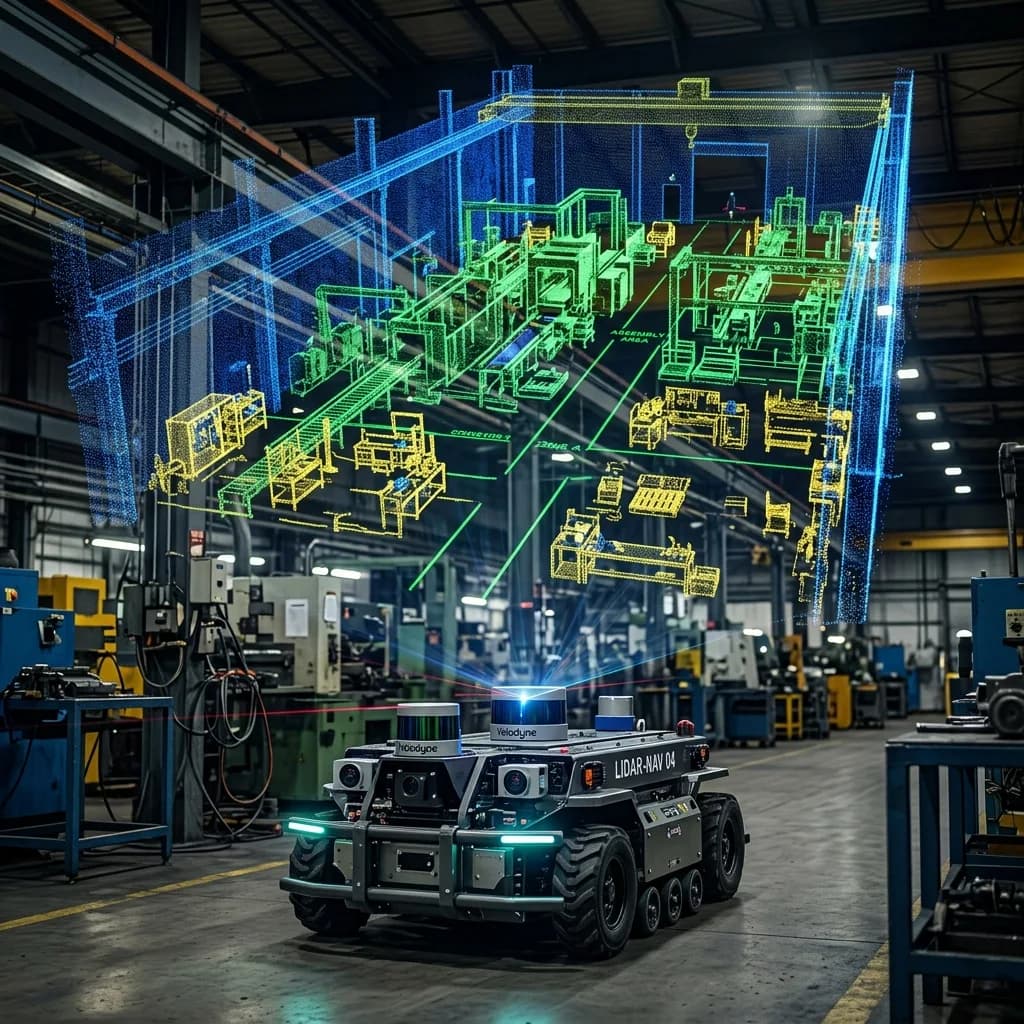
SLAM robotics gives mobile robots the ability to understand their surroundings while continuously estimating their own position. We engineer this capability for indoor and changing industrial environments where GPS may not be available.
Sensing & perception. We fuse LiDAR, depth and stereo cameras, IMUs, and wheel odometry to build a robust view of motion and surroundings.
Mapping & localization. We select LiDAR SLAM, visual SLAM, or hybrid approaches according to the environment, producing maps suited to the application and maintaining stable robot positioning as conditions change.
Path planning & navigation. Global route planning and local motion control manage trajectories, obstacles, dynamic objects, and people, with fleet coordination where multiple robots share a space.
Real-time operation. Perception, mapping, planning, and control run on edge computing hardware for low-latency response without depending on the cloud.
Simulation & validation. We develop and test navigation behaviour in simulation before deployment, refining sensors, maps, trajectories, obstacles, and recovery behaviour for applications including autonomous mobile robots, industrial inspection, and material movement.