
Why Train in Simulation
Training robots in the real world is slow, expensive, and sometimes dangerous. In simulation we get scale (thousands of robots learning in parallel), safety (failures cost nothing), speed (faster-than-real-time trials), data (perfectly labeled, on demand), and coverage of edge cases that are rare or hazardous to stage physically. Simulation is how modern robotics and "physical AI" are actually built.
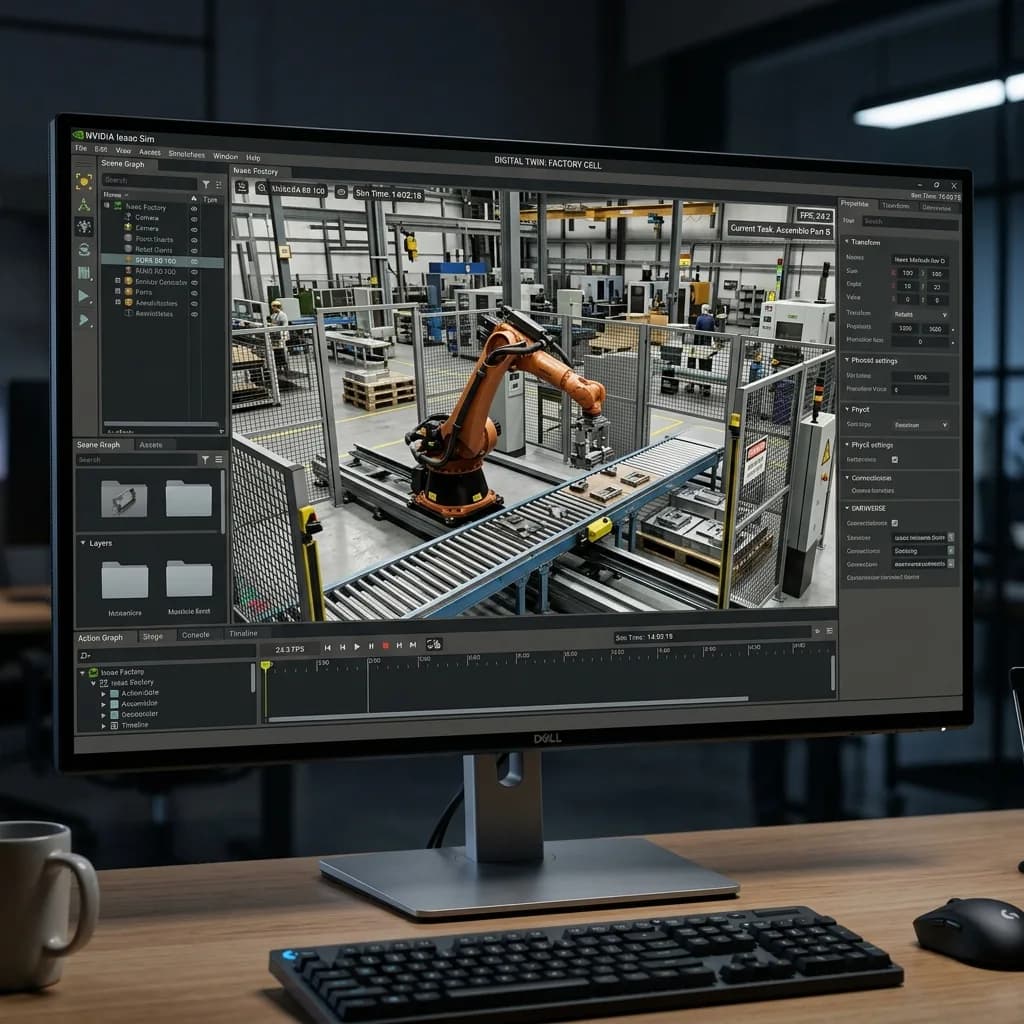
Photorealistic Virtual Worlds
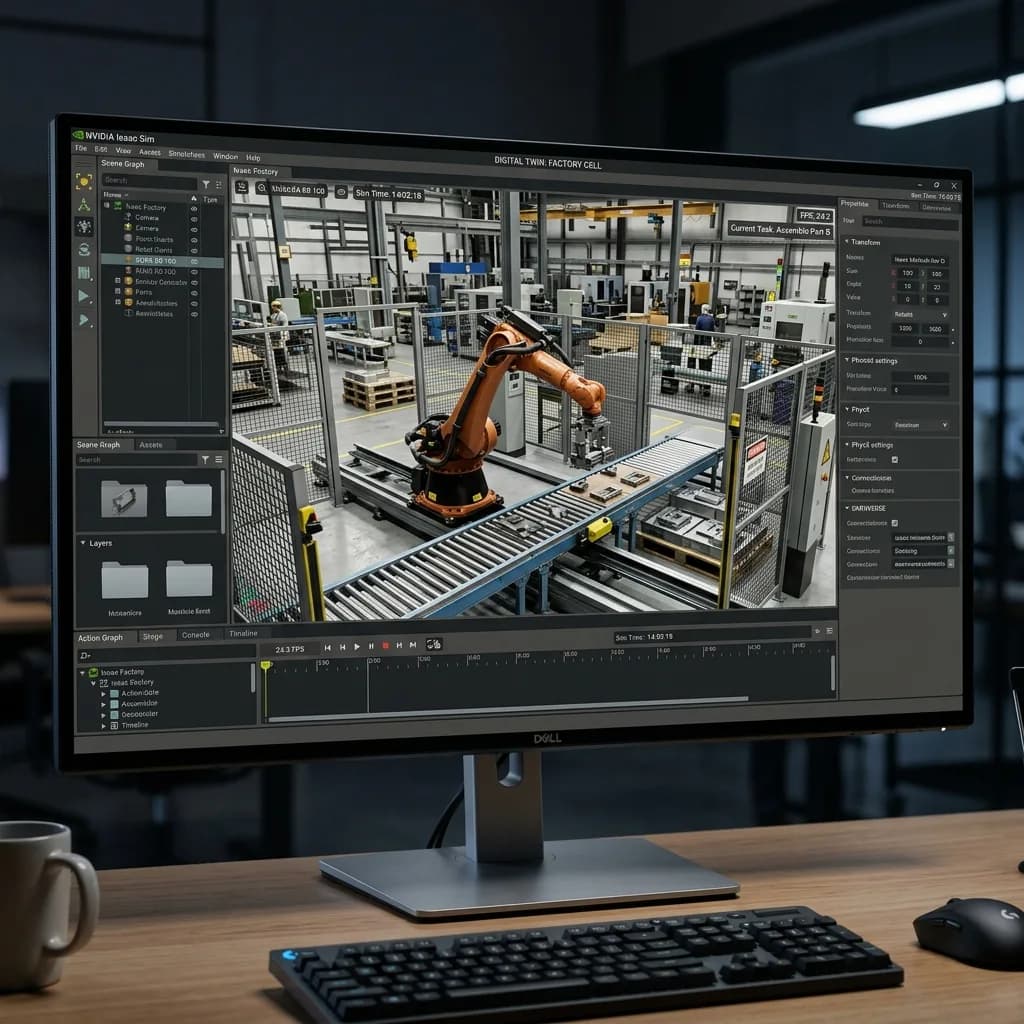
We construct physically accurate, photorealistic virtual environments — factories, warehouses, and work cells — with realistic physics, lighting, and sensor behavior. Built on platforms such as NVIDIA Omniverse and Isaac Sim, these worlds are often digital twins of real facilities, so what a robot learns indoors-virtual maps cleanly onto the real site.
GPU-Accelerated Training & Reinforcement Learning
Learning happens through GPU-accelerated reinforcement learning at massive parallelism — many simulated robots exploring and improving simultaneously on the NVIDIA CUDA stack (using environments such as Isaac Lab). Domain randomization — varying textures, lighting, physics, and noise across runs — forces policies to be robust rather than overfit to one perfect virtual world, which is the key to making them work in reality.
Synthetic Data Generation
A major bottleneck in industrial computer vision is the lack of labeled data, especially for rare defects. We generate synthetic, automatically-labeled training data in simulation — thousands of photorealistic, perfectly annotated images across endless variations of part, pose, lighting, and defect (using tools such as Omniverse Replicator). This trains vision models that would be impractical or impossible to train on real images alone, and complements the computer-vision work on the Artificial Intelligence page.
Sim-to-Real Transfer
The point of simulation is the real world. Sim-to-real transfer is the discipline of getting policies and models trained in simulation to perform reliably on physical robots — through domain randomization, careful calibration, and on-robot fine-tuning. We engineer for this gap deliberately, validating in stages from sim, to controlled pilot, to production.
The NVIDIA Ecosystem We Build On
We leverage the NVIDIA ecosystem for "physical AI" — including Omniverse and Isaac Sim for simulation, Isaac Lab for GPU-accelerated robot learning, CUDA/TensorRT for training and optimized inference, and Jetson for on-robot edge deployment. We treat these as powerful tools in service of outcomes, and remain free to combine them with open-source simulators and frameworks where that serves the problem better.
Framing note: Reference NVIDIA technologies as tools Veyrion uses, not as a formal partnership or endorsement, unless/until a partnership is in place. Keep claims accurate and avoid version-specific statements that date quickly.
Industrial XR — VR & AR
Simulation and digital twins become even more powerful when people can step inside them. Veyrion uses VR and AR across the lifecycle:
immersive design and layout review, safe operator and maintenance training in virtual replicas of real environments, and remote walkthroughs of facilities and twins.
guided assembly and maintenance with step-by-step overlays, hands-free remote-expert assistance, and projecting a digital twin's live data onto the physical equipment a technician is looking at.
controlling and supervising robots remotely through immersive interfaces, with the digital twin as the operator's window.