Why Robotics, Why Now
Robotics is moving from fixed, single-task machines to flexible, intelligent systems that perceive their environment and adapt. Veyrion treats robotics as a strategic growth area and a core innovation pillar — investing in the autonomy, perception, and coordination that make modern robotics viable on the plant floor, in the warehouse, and beyond.
Research & Development
robotic systems engineered for manufacturing and industrial tasks.
machines that sense, decide, and act with minimal human intervention.
autonomous mobile robots (AMRs) for material movement and inspection.
cobots and workflows where people and robots work safely side by side.
the AI that gives robots perception, planning, and adaptability.
orchestrating many robots as a coordinated, observable fleet.
visual perception for guidance, inspection, and navigation.
mapping, localization, and path planning in dynamic environments.
engineering robotics to operate safely around people and assets.
Applications
We apply robotics research to material handling and intralogistics, automated inspection, precision assembly, autonomous facility operations, and human-robot collaborative cells — always engineered for the specific operation, not dropped in off the shelf.
Robotic Intelligence (AI × Robotics)
The hardest part of modern robotics isn't the hardware — it's the intelligence. Veyrion's AI and robotics teams work together so that perception, decision-making, and coordination are engineered as one system. This is where our cross-pillar approach is a decisive advantage.
Safety First
Robotics earns its place only when it's safe. We design safety systems, fail-safes, and human-robot interaction patterns from the start, aligned to industrial safety expectations.
Autonomous Navigation & SLAM (deep dive)
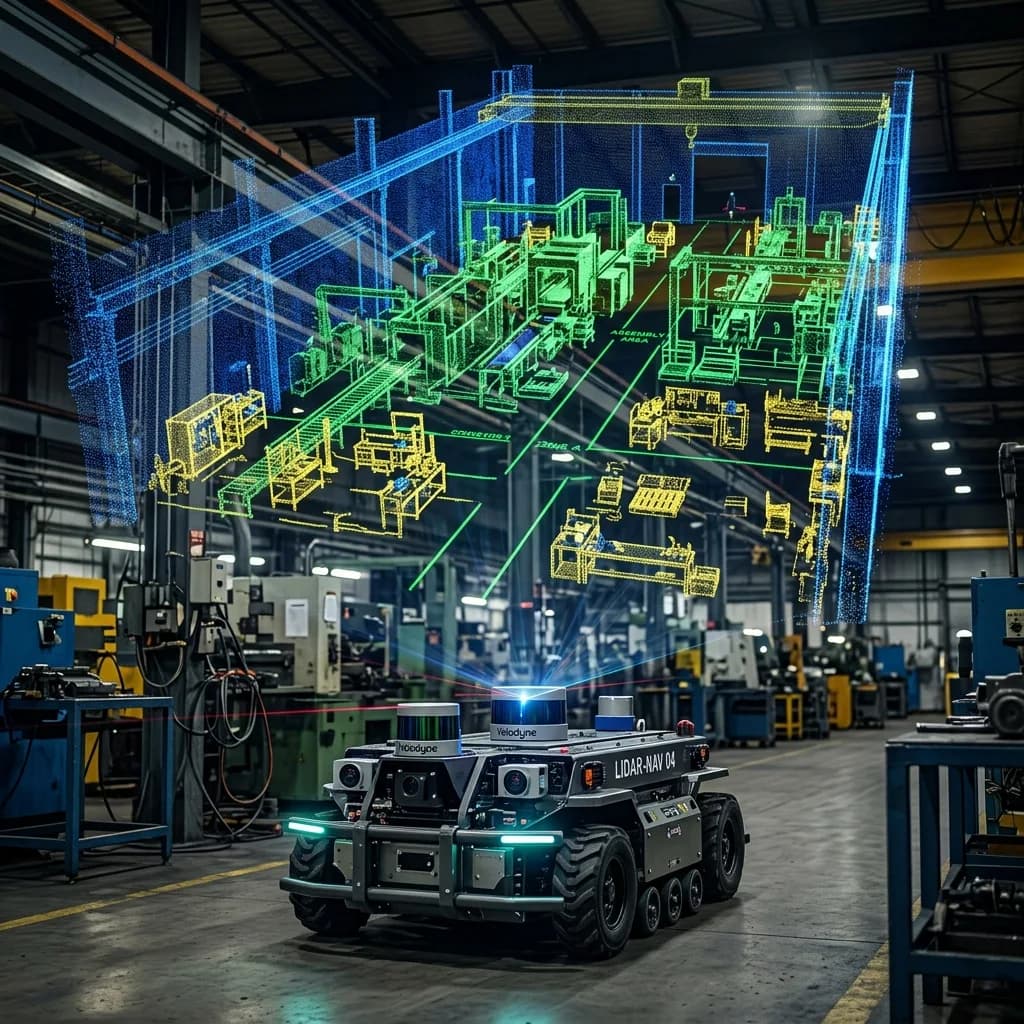
For any robot that moves, the central problem is SLAM — Simultaneous Localization and Mapping: building a map of an unknown environment while simultaneously tracking the robot's own position within it. SLAM is what lets an autonomous machine operate in a real, changing facility without external guidance — including in GPS-denied indoor environments.
Sensing & perception. We fuse data from LiDAR, depth and stereo cameras, IMUs, and wheel odometry. Sensor fusion gives a robust estimate of motion and surroundings that no single sensor can provide alone.
Mapping. Depending on the environment we apply LiDAR SLAM, visual SLAM, or a hybrid — producing occupancy grids, point clouds, or 3D meshes. Pose-graph optimization and loop closure keep maps globally consistent as the robot revisits places it has seen before.
Localization. Techniques such as particle filters, Kalman/extended-Kalman filtering, and scan matching keep the robot confidently located in real time, with relocalization to recover if it gets lost.
Path planning & navigation. Global planners chart the route; local planners handle real-time obstacle avoidance, dynamic objects, and people — coordinated across a fleet when many robots share a space (see Robot Fleet Management above).
On the edge, in real time. Perception, mapping, and planning run on-board on edge compute (e.g., NVIDIA Jetson), so navigation keeps working with low latency and without depending on the cloud.
Where it's applied: autonomous mobile robots in warehouses and factories, autonomous inspection of facilities and assets, and material movement through dynamic industrial spaces. Much of this navigation stack is first developed and hardened in simulation before it ever touches hardware (see Robotics Simulation & GPU Training).