
What a Digital Twin Really Is
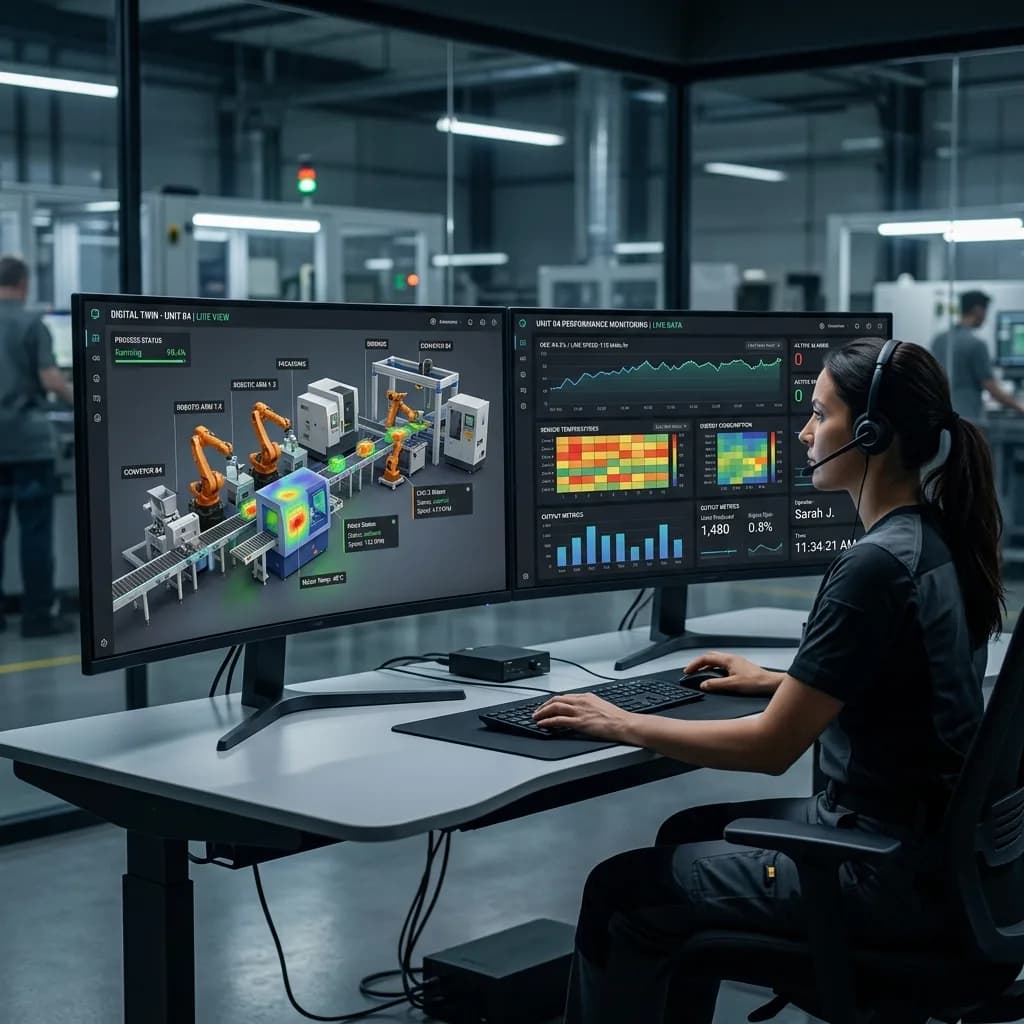
The defining feature of a true digital twin is live, bidirectional synchronization: real-world data flows from sensors into the virtual model so it reflects current state, and insight flows back to inform decisions and control. A static 3D CAD model is not a twin; a model that breathes with live telemetry — temperature, position, vibration, throughput, wear — is.
The Levels of Twin
a single machine or part (e.g., a robot, a motor, a pump), modeled down to the sensors and components that make it up.
a robot's geometry, kinematics, and live state, used for monitoring, programming, and simulation.
a connected line or cell, modeling flow, bottlenecks, and interactions between the machines and people that run it.
a whole plant or operation, for plant-wide visibility, optimization, and coordination across every connected line.
What a Twin Enables
an intuitive, real-time picture of complex operations, so anyone can understand what's happening at a glance.
live state and health, anywhere, with alerts the moment something drifts outside normal operating range.
test changes, layouts, and scenarios virtually before committing physical resources or downtime to find out.
combine the twin with AI to anticipate failures and outcomes before they happen, not after the fact.
find better operating points and continuously improve performance without disrupting the live operation.
train people and operate assets safely from a distance, including via VR/AR, without physical risk.
How We Build Them
We assemble twins from four ingredients: accurate 3D/geometry (from CAD or scanning), real-time data (from the Industrial IoT and control systems), physics and behavioral models (so the twin behaves like the real thing), and AI (so it predicts and optimizes). The result is delivered through the right surface — a web dashboard, a 3D viewer, or an immersive VR/AR experience — and runs across edge and cloud as latency requires.
The Twin + Simulation + AI Loop
A digital twin is most powerful as part of a loop: the twin mirrors reality, simulation explores possible futures on top of it, and AI learns from both to recommend or take action — with results flowing back to reality and, in turn, back into the twin. This is also how we safely train robots and policies before deployment (see Robotics Simulation & GPU Training).
Access Anywhere
Twins are made to be used. We surface them as live web dashboards for everyday monitoring, immersive VR walkthroughs for design review and training, and AR overlays that project the twin's data onto the real equipment in front of a technician (see Industrial XR on the Simulation page).